

Menopause symptoms last seven years, on average, with it lasting up to a decade for Black women. Think about how long that is. Seven years is long enough to pay off a car and start shopping for the next one. Long enough to walk a kindergartner all the way to seventh grade. Long enough to refinance a mortgage and watch a company you invested in double or disappear. When you believe something is a moment, you brace for it. When you know something is a season, you plan for it, and you fund it. Menopause can be an expensive season. Here are the numbers that prove it.
Seven Years is a Long Time
Researchers followed approximately 3,300 women for 17 years in a study called SWAN (The Study of Women’s Health Across the Nation). They lined every woman up from shortest symptoms to longest and looked at the woman standing right in the middle. She had symptoms for 7.4 years. Researchers call that middle number the median. Half the women had it easier. Half had it harder.
For Black women, the woman in the middle had symptoms for 10.1 years. And symptoms did not stop when periods stopped. For the woman in the middle, they kept going another 4.5 years past her final period.
Half of all women have symptoms longer than 7.4 years. That means the odds of this being short for you are a coin flip.
Now here is what I want you to notice. We call it “the change.” One word. Singular. Like something that happens to you on a Tuesday afternoon and is over by Friday.
That word is costing women money.

The Number Nobody Budgets For
A 2023 Mayo Clinic study of 4,440 working women put a price on the cost of menopause symptoms.
Lost work time for menopause came to $1.8 billion a year.
That phrase, “lost work time,” sounds abstract. So let me tell you what it actually looks like on a Tuesday morning.
- A woman calls in sick because she got two hours of sleep and cannot think straight.
- A woman drops to four days a week, and her paycheck drops with her.
- A woman sits in a meeting she could have led because a hot flash hits and she can’t find her words.
- A woman quits a job she was good at because it became too much.
Add up all those Tuesdays across the country, add in the medical bills, and the total comes to $26.6 billion a year. Mayo Clinic wrote about the findings in their own summary of the study.
Now set a second number beside that one. Bankrate’s 2026 Emergency Savings Report asked Americans a simple question: could you handle a surprise $1,000 bill right now? Fewer than half said yes. About 1 in 4 have no emergency savings at all. And 1 in 3 said they would have to borrow to cover it.
Most people cannot pay for a single $1,000 emergency. Menopause doesn’t send one bill. It can bring years of expenses.
Nobody hands you a plan for this at the kitchen table. Your mother probably managed it in silence. Your benefits handbook barely mentions it. So we must build the financial plan ourselves. That begins by figuring out where the money really goes.

The Menopause Tax™: Three Places It Collects
Every woman who reaches midlife goes through menopause. The average age is about 52. However, menopause also doesn’t arrive on the same timeline for everyone. Women of color commonly experience earlier onset than white women and are more likely to face premature menopause (before age 40) or early menopause (40–44), both of which carry their own added long-term health risk.
Perimenopause, the years of hormone changes before your final period, can start in your early 40s.
Here is the part that matters for your money. The cascade of costs and health risks often occurs during your best earning years, when your paycheck and your retirement savings carry the most weight they will ever carry.
I call the cost the Menopause Tax™, because it collects in three places at once.
Care Costs: the bills insurance leaves to you
A 2025 GoodRx survey of 1,500 women asked who had insurance coverage and who was paying out of pocket. Here is what they found:
- Only 1 in 4 women had full insurance coverage for menopause prescriptions.
- 1 in 5 women delayed or skipped treatment because of cost.
- About 1 in 8 women cut back on essentials, groceries, and household basics, just to afford their care.
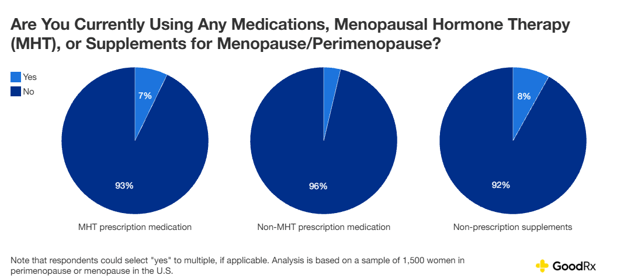
Costs stack up. Prescriptions, over-the-counter products, and supplements each carry their own monthly bill. Some women are paying $50 to $100 or more per month in just one of those categories alone. Then comes the visits. Add labs, pelvic floor physical therapy, a sleep evaluation, and mental health support.

Career Costs: the money you never see leave
A Mayo Clinic study measured what menopause symptoms cost women at work. About 1 in 7 said symptoms cost them something concrete: missed days, cut hours, a missed promotion, or their job entirely. Missed days show up on a paycheck. The missed promotion never does. It just quietly stops compounding.
That gap between the visible and the invisible shows up again when you ask employers what they think is happening. A 2023 Bank of America report asked women directly, and half said menopause had hurt their work life. But only about 1 in 7 believed their employer even saw the need for menopause benefits. The cost is real to the woman living it and invisible to the person deciding whether to do anything about it.
Leave that gap unaddressed long enough and the UK shows where it ends. In a Fawcett Society survey of 4,000 women aged 45 to 55, 1 in 10 left a job because of symptoms. About 1 in 7 cut their hours. About 1 in 12 decided not to apply for a promotion. None of that shows up as a line item anywhere. It just shows up later, as a smaller paycheck and a smaller retirement account.
Sick days are the cost you can see. The promotion she never applied for is the money you never see leave.
Compounding Costs: the invisible third bill
Career losses follow you past your paycheck. Fewer hours means less going into your 401(k) and a smaller match from your employer. A promotion you skip holds down every raise that would have been built on top of it.
And money pulled out of investing in your 50s costs more than what you took. Ten thousand dollars left in an account at age 50 could grow to about $27,600 by age 65, if it earns an average of 7% a year. Take it out instead, and you lost the $10,000 and the $17,600 it would have made.
The move I most want to keep you from is the panic withdrawal. Pulling from a 401(k) before age 59½ usually means paying income tax on it plus a 10% penalty on top. This fund exists so you never have to raid your 401(k) to cover a menopause bill.
One Woman’s Year, With the Meter Running
It’s easy to overlook big national statistics. Instead, I want to show you what one year looks like for one woman, so you can see the impact up close.
Picture a 49-year-old finance manager working at a regional bank. Her health insurance comes with a $2,000 deductible, so she has to pay that amount out of pocket before her coverage really kicks in. She’s got a 401(k), a teenage child, and everyone knows she never misses work on Mondays. But in January, she starts waking up at 3 a.m., drenched in sweat.
See how much her year of care costs. Each line shows an actual category of menopause care. The dollar amounts are examples based on a typical mid-range plan, so think of them as one possible year.
| Month | Menopause Care | Her Cost | Running Total |
|---|---|---|---|
| January | primary care visit, labs ordered | $180 | $180 |
| February | lab work (applied to deductible) | $340 | $520 |
| March | menopause specialist (does not take insurance) | $425 | $945 |
| April | hormone therapy starts ($65/mo through December) | $585 | $1,530 |
| June | sleep evaluation after months of 3 a.m. waking | $390 | $1,920 |
| July | misses 3 days of work (unpaid) | $620 | $2,540 |
| September | pelvic floor therapy (8 visits at $55) | $440 | $2,980 |
| October | counseling for mood changes (6 sessions) | $300 | $3,280 |
| December | smaller bonus after a flat review year | $2,800 | $6,080 |
| Year-end total | $6,080 | ||
Note: The categories of care are real, but the dollar amounts are illustrative, built on a mid-ranger employer plan with a $2000 deductible. They show how costs accumulate across a year rather than reporting survey averages.
Six thousand dollars. Each expense was for care she truly needed, and each one caught her off guard in January. She made smart choices all year. Still, her body followed its own schedule, one her spreadsheet could not predict.
Now see where the largest expense landed: December. Instead, it showed up as a smaller bonus, after a year when she was too tired to volunteer for the projects that would have gotten her noticed by the VP. That is the Menopause Tax™ at work, less money at the end of the year, and no idea where it went.
Run that same year seven times. That is the math nobody told her about.

Why Your Regular Emergency Fund Falls Short
Standard advice says to save three to six months of expenses for a job loss, car trouble, or a leaking roof. But that advice assumes three things menopause doesn’t follow.
- First, it assumes emergencies are rare and random. Menopause isn’t. It comes for every woman who lives long enough, and it runs about seven years on average. You get years of warning, not a surprise.
- Second, it assumes one problem at a time. Look back at that table: a specialist bill, a smaller bonus, and a new prescription all landed in the same twelve months. Add aging parents, tuition, or your own student loans hitting the same years, and a fund built for one problem is trying to solve three.
- Lastly, your regular fund is probably already spoken for. A thin fund drains fast across a seven-year season. Then you may need to move some bills to your credit card, where interest starts working against you.
Menopause is best supported with at least 12 months of savings.
The Menopause Emergency Fund Formula
Twelve months isn’t one pile of cash. It has three different jobs to do: cover care, protect your career, and keep you out of your retirement account. Each layer covers a different place the Menopause Tax™ collects.
Layer 1: The Care Buffer
Aim for $3,000 to $5,000, or whatever your plan calls your out-of-pocket maximum, which is the most you can be asked to pay in one year before insurance covers the rest. This layer pays for a year that looks like the table above. Pull out your plan documents and find two numbers: your deductible and your out-of-pocket maximum. That range is your exposure. Fund it before your symptoms pick the timing for you.
Layer 2: The Career Buffer
Aim for two extra months of essential expenses, on top of your regular emergency fund. This layer covers the costs that don’t come with a receipt. A smaller bonus because you cut back at work. A deliberate move to an employer who actually values you. Cash gives you choices. A woman with this layer can push back on an unreasonable ask, or walk out the door on her own terms.
Layer 3: The Compounding Shield
Make a promise to yourself. The first two layers exist so you never pause your retirement contributions, never borrow from your 401(k), and never pull money out early to get through this. If you are 50 or older, you can also put in extra each year, which the IRS calls catch-up contributions. Protecting those years is the most valuable money move of this entire season. Here’s how to start it.
Three Ways to Build It, Starting This Week
If those numbers feel far away today, start anyway. It takes three moves.
1: Open it and name it
Open a high-yield savings account at an FDIC-insured bank, separate from your checking. A high-yield money market account works too, if your bank offers one. A different bank helps, because money you cannot see in your everyday app is money you leave alone. Then name it. “Menopause Fund” on a login screen makes you stop and think before you touch it, and that pause is the whole point. Keep it somewhere you can reach in a few days, so skip investing accounts and any CD that charges you for taking money out early.
2: Automate one transfer, then feed it found money
Set up an automatic transfer every payday and let it run. Fifty dollars a paycheck becomes $1,300 in a year, and automation spares you the monthly negotiation with yourself. Then send it every dollar that shows up unplanned: a tax refund, a bonus, a raise, side income. That found money builds these layers faster than steady transfers ever will.
3: Spend your employer’s dollars before your own
If yours covers menopause telehealth, therapy, or a Health Savings Account (HSA), use those dollars first. Bank of America found that about 2 in 3 women want menopause-specific benefits, and most employers haven’t caught up yet. Until yours does, an HSA or FSA is the tool already sitting in your benefits package. An HSA is worth asking about if you have a high-deductible plan. It’s pre-tax going in, tax-free growing, and untaxed coming out for qualified medical care.
Don’t have a high-deductible plan? An FSA offers the same pre-tax break, but the money doesn’t carry forward the same way. For 2026 the limit is $3,400, and only $680 can roll into next year if your employer allows it. That makes an FSA a good fit for costs you can predict, like a PT copay you already have scheduled. It’s a riskier fit for a symptom load that might double one year and disappear the next. Check your plan’s rules before counting on either account.
And three rules to keep it whole
- This money is for menopause only. Care costs and income gaps. A new roof still comes from your regular emergency fund.
- Care your doctor recommends is always a fair use of it. Please do not skip treatment to protect a balance. Skipping care doesn’t save money. It just moves the cost from lost workdays and a promotion you step back from now, to unmanaged hot flashes, cardiovascular risk, and dementia risk later. One in five women already delays care due to cost, and this fund exists to help you avoid that.
- Refill what you spend. A withdrawal starts the transfers again the very next payday.
The Morning It Pays Off
Let’s revisit the finance manager and imagine her March going differently.
She sees the same specialist, gets the same $425 bill, and the invoice still says insurance will not cover it. She stands at the checkout window, phone in hand.
But this time, something is different. She opens her banking app, selects her Menopause Fund account, and pays the bill. She doesn’t have to figure out which card to use, worry about interest adding up by August, or debate whether she really needs the follow-up visit.
She pays, heads to her car, and arrives at work on time.
That’s the real benefit of this account. It’s not about building wealth, but about being able to get care when your doctor recommends it and feeling secure while you do.
Menopause is the most predictable emergency you’ll face financially. Research shows it lasts about seven years for most women, costs $26.6 billion a year nationwide, affects half of working women’s careers, and causes one in five to delay care because of money.
You can’t control when perimenopause begins, but you can decide which account will be ready for you.
Here’s one thing you can do: open the account this week and set up your first automatic transfer. Give it a name you can’t ignore. The Menopause Tax™ will come either way, but you get to choose which account covers it.

Dr. Kimberly Derezil, MD, WMCP®
Wealth Management Certified Professional® | Founder, Meno & Money™
Dr. Kimberly Derezil, MD, MSCP, WMCP® is a double board-certified physician and the founder of Meno & Money™, an educational platform for high-performing professional women and the organizations. She created The Menopause Tax™, a framework that names what perimenopause costs women in income, retirement security, and career momentum. Her work treats menopause as a high-stakes financial transition as much as a medical one — and shows women exactly how to protect themselves through it.
Impact of Menopause Symptoms on Women in the Workplace. Faubion SS, Enders F, Hedges MS, et al. Mayo Clinic Proceedings, 2023;98(6):833-845. Survey of 4,440 employed women. Source for $1.8 billion in lost work time, $26.6 billion total, 13.4% adverse work outcomes, 10.8% missed work, and the 15.6 times higher odds among women with the most severe symptoms. Mayo Clinic’s plain-language summary is here.
Duration of Menopausal Vasomotor Symptoms Over the Menopause Transition. Avis NE, Crawford SL, Greendale G, et al. JAMA Internal Medicine, 2015;175(4):531-539. Study of Women’s Health Across the Nation (SWAN), 3,302 women followed from 1996 to 2013. Source for the 7.4-year median symptom duration, 10.1 years for Black women, and 4.5 years past the final period.
The Cost of Menopause: New Survey Highlights Financial Struggles. GoodRx Research, survey of 1,500 women conducted February 2025. Source for 26% with full prescription coverage, 21% delaying or skipping treatment, 12% cutting back on essentials, and the monthly spending ranges.
2026 Annual Emergency Savings Report. Bankrate, published February 2026. Source for 47% able to cover a $1,000 emergency, 24% with no emergency savings, and one-third who would go into debt.
Break Through the Stigma: Menopause in the Workplace. Bank of America, June 2023. Ipsos polls of 2,000 women aged 40-65 and 500 benefits decision-makers. Source for 51% reporting negative work impact, 64% wanting menopause-specific benefits, and 14% believing their employer recognizes the need.
Menopause and the Workplace. The Fawcett Society, April 2022. Survey of over 4,000 UK women aged 45-55. Source for 10% leaving a job, 14% reducing hours, and 8% not applying for a promotion.
Economic Well-Being of U.S. Households in 2024. Federal Reserve Board, Survey of Household Economics and Decisionmaking (SHED), published May 2025. Reports that 63% of adults could cover a $400 emergency with cash or its equivalent, meaning roughly 1 in 3 could not.
You may also like…

A Guide To Over-the-Counter (OTC) Menopause Supplements: Relief in a Bottle?
The menopause supplement guide provides information on key non-hormonal ingredients for symptom relief so you and your doctor can determine which one(s) may or may not work for you.

Why Your Doctor Might Not Be Well-Informed About Menopause And How To Take Action
Has your doctor asked you menopause? Learn why your doctor may not be well-informed and how you can find a menopause doctor.

Naturopathic, Integrative, and Functional Medicine: Holistic Health for Menopausal Women Explained
What’s the difference between naturopathic, integrative, functional, and Traditional Chinese Medicine?